
Through the Wormhole Co.'s Are You Thinking What I'm Thinking?
"It’s about pulling things from the mundane or everyday and making them weird and strange."
Zöe Braithwaite, SFU Theatre Performance Alumni ‘23
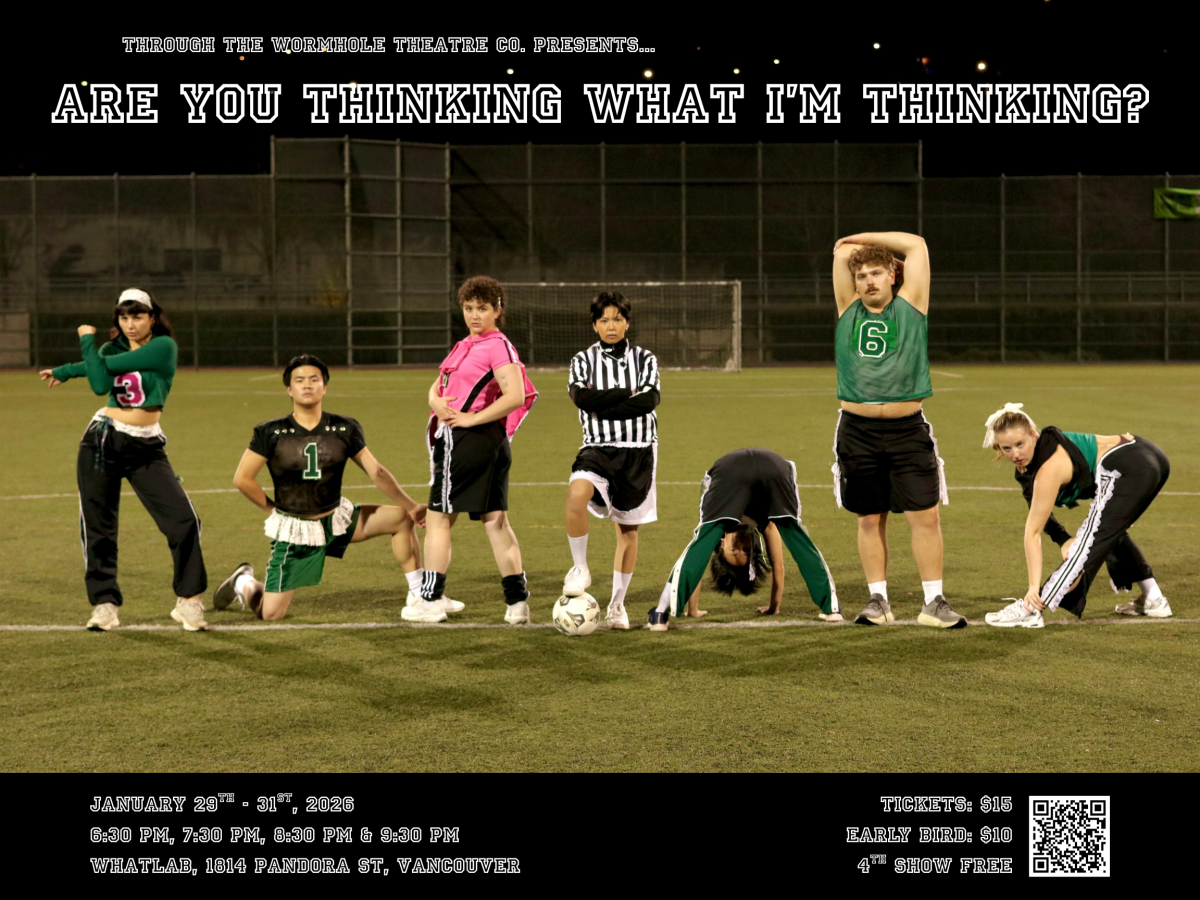
Remounted at independent performance venue What Lab, Through the Wormhole Co. staged a reworking of Rosemary Morrison’s former Capstone Project, Are You Thinking What I’m Thinking? That ran from January 29th - 31st 2026. Although this piece belongs to a history of repeated efforts, it takes the stage as Through The Wormhole Theatre Co's first independent production. Originally staged in March 2024 at SFU’s School of Contemporary Arts, the piece was adapted with homoeroticism of sports, campy queerness, the intersections of improvised and rehearsed theatre and mixed audience models in mind.
Coated in candy colored queerness and dressed in the soft artificiality of astro turf, Are You Thinking What I’m Thinking? exists in a world of shameless sincerity, borrowing erotic athletic rituals and the hormonal pitilessness of high school. Reminiscent of cult classics and familiar favorites such as But I’m a Cheerleader, Bring It On and Challengers, Through the Wormhole is a collective that operates as one brain that never shies away from placing a mirror to the cultural zeitgeist. With glimpses at the idiosyncrasies of a group of well adjusted friends, the contemporary theatre collective never fails to feel like an invitation into an intimate experience that otherwise would be all too covert to insert oneself into.
Below is the culmination of four separate interviews with the cast of Are You Thinking What I’m Thinking?, joined at the hip and reconfigured. Like the cult classics they evoke, Through the Wormhole Co is sure to gain the traction it deserves.
Dean Thivierge: What were some of the first moments you had going into this process…pictures, hunches, and first influences?
Rosemary Morrison: I started this project when I was in my 4th year at SFU doing my Capstone Project. I have been in the contemporary theatre world but also very deep in the improv comedy world and those two worlds don’t really collide too much! The intention was to find some sort of bridge. In the early stages it was crazy, it was trying to build a game. I thought of kiss or slap really early on so that was the base concept for a while. Then it kind of developed into sports…ish? We were originally a varsity team and now it’s turned into its own weird sport. Starting up round two of this show, I worked a lot with Shaeah Kim, our costume designer, to create a Pinterest board that is a lot more “yassified sports”.
D: It’s very But I’m a Cheerleader and Bring It On.
R: But I’m a Cheerleader, Bring It On,Challengers, and eventually Heated Rivalry. We were already working on this and then Heated Rivalry came out and we were like “well well!”
D: I feel like this is the time for this piece 100%. On that note: what was the process of devising and staging like?
R: Throughout the whole process we have met once weekly instead of being really intense about it. A lot of it is just helping performers coming out of SFU to be a bit more comfortable with improv but I think they’re already pretty well trained in it. Then a lot of it started to turn into how do we merge some of that training with more sports stuff and bring the tension up. A lot of it was playing around with things. Training people how to be more toxic was a big focus for us. [laughing]
D: [laughing] For sure!
R: We were starting to build this world around this game that they play.
D: I feel like the pacing around these little tabloids was really well done. You really emphasized how long the start up before a game is. It’s ridiculous! I’m in the stands and no matter what game it is. I’m like: “and there they go!” “and there’s the music”. The work was really getting into the ritual of it all. It was really exciting in that way.
R: And why do they stretch like that? [laughing]
D: Yes! So much beef!
R: We really need to dive further into the homeroticism of sports. It already existed but we wanted to drag that out.
D: It pulled all of that to the forefront and then used improv as a means of delivery. Just generally, I remember telling you off the books that this is a very natural progression of SCA stuff. The way it’s partitioned with asides is very Capstones informed.
R: Yes yes absolutely!
D: I caught some glimpses of Jae’s personal style in there.
R: Yeah! Jae has been amazing as a Stage Manager, doubling up as the referee. He’s performing and calling cues at the same time.
Dean Thivierge: How would you say your personal practice influenced the process of remounting Are You Thinking What I’m Thinking?
Zoë Braithwait: In some of the shows I’ve worked on before I’ve tried to work with audience participation. Whenever you bring that in you’re always doing some level of improv. I’m not an improv person. It’s very new to me to be doing improv. It’s interesting to have a container for something but be not sure about how it will play out. It’s about pulling things from the mundane or everyday and making them weird and strange. Sports and toxic situationship romances are all so familiar before it's amplified into this campy world. Making it bigger to play inside of is something that I’m really into and see in this show.
D: I think the space you guys picked out is really good for this. What Lab is just the right amount of intimate and professional.
Z: I love the way we set up the audience.
D: Alley is perfect!
Z: So much of this show is about eye contact. You have the audience that is paired up to make eye contact with each other. You build off of people’s reactions when you see it. We wanted to encourage the audience to build off of each other’s reactions. It’s set up like a tennis match balancing back and forth.
D: I feel like a lot of people might say differently about this but I think it was really nice how you can see everyone in the space.
Z: Exactly!
D: How much of the piece was improvised and how much was rehearsed?
Z: It’s very unique in the way that you go into it with no idea of what is going to happen but you’re still aware of all these rules that we built in. As a performer it’s one of the most difficult shows I’ve done. Each round has its own rules. The first round is building out these characters, their backgrounds and their relationships. Even our warm up routine has rules: you look at the person when they enter but you have to look away before they make eye contact with you. There are rules like that, that live within it. We know the show is going to end in a kiss or a slap but how we get there is totally improved. Even who is going in for the conversation in round 2, that we don’t discuss someone just steps in.
D: In round one, I feel like that improv game you were playing was kind of like “life with me is like”.
Z: Yeah, we would play that in our warm ups!
D: But like a c*nty campy sports goofy version of that! [laughing]
Z: But it was so intense because we have to come up with the bits but also remember everything the other person was saying. It happened in this show (January 31st, 9:30 pm) where we started contradicting each other. Where we’re like: “she’s a virgin…but she’s also really submissive in bed…but she is still a virgin!” [laughing]
D: [laughing] That was sweet, that was really good. I was honestly looking at Muby (Ruby Maher) the whole time for that, she was selling it to the point where I was like “hmm this doesn’t feel like improv?” For a bit I thought it was just the names that were changed. It’s really sick to know that it was that specific improv game informing it. For round two was that aside improv as well?
Z: Yeah, the whole conversation is total improv. We’re just trying to build off of the facts from round one.
D: That felt very Lachlan. [both laughing] Is that wrong to say?
Z: [laughing] No, I don’t think so!
D: It was absurd and then serious and then back to absurd in a really beautiful way.
Dean Thivierge: How did your personal practice influence the piece?
Lachlan Harris-Fiesel: My personal practice is very spontaneous. It’s a lot like Rosemary’s. It's about people. It’s connected to interpersonal relationships and how that connects to how people live and work. This show is very much that. It’s very “screw it let’s do it live!”
D: I didn’t realize how much of the piece was raw improv until I talked to Zöe about it. The aside with TJ and Ruby was so tight that I had no idea. I’ve told quite a few people that I’ve interviewed so far that that section had you written all over it.
L: [laughing] You thought that was me? Which part?
D: The whole section. Was it (your idea)? Or no?
L: The talking? It was Rosemary’s idea. It was Rosemary’s baby. It’s a devised piece and Rosemary works in a very non-hierarchical way. She’s really good at taking ideas from people. The whole thing was her idea but there are bits and pieces that come from people.
D: Any specifically you?
L: I feel like I bring some of my personal experience with sports to the show. I played rugby for a while in middle school and high school. At the end of the day rugby is a pretty homoerotic sport. A lot of the show is built around homoeroticism and this questioning of sexuality. When I was questioning when I was younger a lot of that came out in rugby. It was a lot of “there’s like ten sweaty dudes grabbing on each other right now”. I brought a lot of experience coming from the locker room and what that’s all about. No ideas, just my experience. [laughing]
D: You guys formed this brilliant collective post-SFU, could you speak on that?
L: It started in May last year– coming up on the one year when Rosemary and I were sitting at Grounds for Coffee on The Drive and Rosemary came to me with this idea. She was looking at Facebook Marketplace and she found our studio space for rent and she said “Are we going to do this? We keep talking about this– are we going to do it or what??” Yeah yeah we are! Originally the collective was Rosemary and I’s thought child. We’re both spontaneous people, we’re both willing to just do stuff. We’re real doers– real thinkers too. We got all our friends working hard TJ Tan, Jae Gonzales and then built it from there. We have all our friends with us. It’s so nice to work with people you trust and love. It’s really great and we’re going to do sick things!
Dean Thivierge: Going in, how did your personal practice inform the piece?
Ruby Maher: This was completely new to me. My personal practice has always been in movement, in physical theatre and dance. Most of the projects I did at the SCA centered movement a lot. Something like this that was very text based– and I’ve never done improv before– was very daunting walking into at the start but Rosemary is such a wonderful guide. We did so much team building throughout the process and so many improv workshop things that helped me open up and be willing to take on something like this. It was fun to step out of my comfort zone. As far as my personal practice goes, I feel like I was really able to show off my physical comfortability throughout the first warmup section. Unfortunately it really reminded me of being in a dance studio when you’re younger and looking around trying to size up who's more flexible than me. Physicality has always been my thing and being able to hold that posture and gaze was very important for this piece. I was really excited that I got to do something new and try something I didn’t consider to be my wheelhouse. Now I get to put another tool in my toolbox!
D: I was just telling Zöe that during most of the improv bits I was looking at you because I couldn’t make out what was rehearsed and what was improv. And because of your diction that was so certain and decisive. Maybe because you’re not from that “flavor” of improv you kept that way of approaching text.
RM: It’s interesting you say that because I felt like in that section I was doing a calculated sequencing. I’m a dance teacher so at the start of my classes I run through a sequence of stretches in the same order. We start by standing and then go to the floor and then back to standing and some cardio. I took that form for myself then placed it in here at a smaller scale. Yeah it was improv and I did different movements every time but it was also the same format every time. Having that repertoire of movements that I do all the time with my kids helped. I already have a vault on hand.
D: Sweet! How would you describe the rehearsal process?
RM: Amazing! [laughing] It was awesome. Not only is Rosemary so wonderful and really guided me to feel like I could be successful in this kind of project, but also just being able to work with collaborators that are already preestablished. We’re all friends and I think the nice thing is that we come from a school that allows us to establish these connections early on. Not only do we become devisers together and collaborators together but we became besties! Once we all graduated we knew we wanted to continue working together and we formed Through The Wormhole. We rent the studio together and continue to work together as a collective because not only do we know we can work well together but we also know we’ll have fun doing it. I think that’s the most important thing! I remember saying “I don’t want to leave! Can we do this tomorrow?” I think that energy impacts how you walk away from the rehearsal process. I do feel like these people are my family. They don’t feel like my rivals even though it looks like that on stage! I love them to death. The process of working on this was amazing.
D: I think that’s so beautiful and rare that you can have a cohort like that, that is so intact in the next phase of your professional development. It’s so truly amazing to be able to point at this thing and say that it is possible to go through this program and make the kind of art that you want to make.
RM: It’s totally possible. I give the SCA their flowers for curating a group that turned into my family. I never realized that I would get so close to a group of people that think the same way that I think and want to make the same things that I do. There’s no rivalry and there’s no bad blood. It feels like I got embedded in a friend group. Throughout the four years we always worked together in a close circle. I was never in Rosemary, Aisha and Zöe’s cohort but I worked on some projects at the SCA that melded our cohorts that expanded outside of the group of 12 that I work with. Now we’re here and I would change any of it, it’s kind of phenomenal.
D: It really is.
RM: We’re excited to see what the future holds for us. We’re going to Theatre Under the Wire next week so we’re going to be working as a collective for that.
D: Could you talk about that a bit?
RM: Yeah! Theatre Under the Wire is a 48-hour theatre production festival. You have to apply for it and if you’re accepted you get 48-hours to make a brand new theatre piece– which is very convenient for us because we co-lease a studio space together so we’re probably just going to stay up for 48-hours and make a show! Which is awesome! After the 48-hours we perform on the Thursday right after (February 12th, 2026) to a live audience. They give us ingredients– it’s kind of like Run N Gun– they give us ingredients so you can’t preplan it. You have to go meet them and they give us some ingredients to mix into our little recipe we are going to make and then we perform it on that Thursday. It will be fun to see how our collective works under pressure. This is the second iteration of this show, Rosemary has been working on it for a long time. I was in Switzerland during the summer but they started rehearsing for this in August.
D: And it was once a week too so it was pretty relaxed.
RM: Relaxed, prolonged. It will be nice to see how our group can put their heads together in a super short period of time.
Credits:
- Created & Directed by Rosemary Morrison
- Performed by Lauren Han, Lachlan Harris-Fiesel, Katie Gherasim, Ruby Maher, Zoë Braithwaite, TJ Tan, Aisha Wewala & Rosemary Morrison
- Stage Managed by Jae Gonzales
- Costume Design by Shaeah Kim
- Photography & Videography by Clementine Bardonnier
- Sound Design by Liam Murley
Look out for Through The Wormhole Theatre Co’s Theatre Under the Wire entry premiering February 12th, 2026. Be a part of the conversation. Get your tickets, at https://www.vancouverfringe.com/events/theatre-under-the-wire/.